A saying once went, “It’s strange to go to the Lawler’s for a cup of tea – you could be sitting with the prime minister, the governor or the premier.”
Such was Norm Lawler’s domain over the Point Cook Homestead that he hosted the likes of Sir Henry Bolte, world renowned hunters and British peers – teaching them all a thing or two about shooting.
Now 97, the man who earned the moniker ’The Little White Hunter’, is not shooting many quail – or stirring up nobility and having his name endearingly mentioned to Queen Elizabeth II– but he is going guns blazing to save his former abode … again.
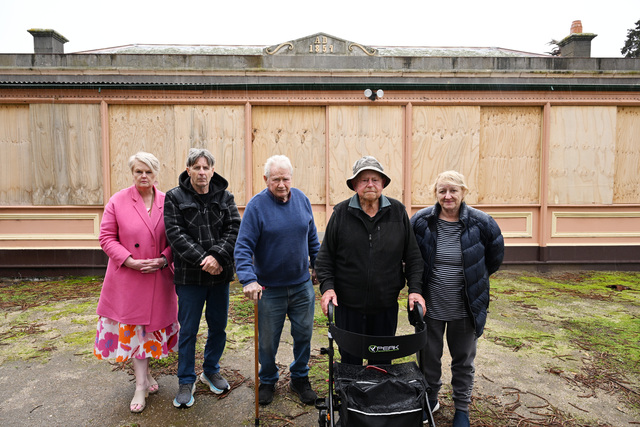
For the last 15 years, the homestead has been vacant, vandalised and arguably in one of the worst conditions it has been in since it was built by the Chirnside family in 1857.
The man whose sheer willpower saved the place in the 1970s and guarded it until 1995 has one simple message:
“After 30 years, the fight begins again.”
To understand the essence of the homestead, you have to understand Norm.
Before he was The Little White Hunter, he was just a lad from Footscray growing up through The Great Depression and World War II who discovered shooting.
“In 1942, during the war, I started an apprenticeship when I was 14 years old at Hansen the builders,” Norm said.
“There was another fellow who worked there and on his bike he used to have this canvas bag tied on the handlebars.
“So I asked him one time, ‘what is in that bag?’”
The teenager laid his eyes upon a gun.
“I said,“ What do you do with it? “ and he said when I knock off work, I ride out along the road there and shoot a rabbit or two.
“I got interested and he said ‘would you like to come with me.?’”
During the austerity of the war, it was common for people to jump the train and head to towns to hunt rabbits in spots like Werribee and Geelong for supper or a few sixpence.
The “Rabbiters Express “ would leave every Sunday morning at 6.30am for Geelong.
“On the way through Yarraville, Newport and all those places, blokes would be getting on the train with boxes of ferrets, nets and guns, and they were going out to get a feed for their families,” Norm said.
“That is where shooting started with me.
“Gradually I started to get known as a guide for shooters and then a doctor rang up one time and said ‘would you be able to take me out shooting?
“Shooting was a way of life, most houses had a rifle because rabbits were all you could get.”
In 1944-1945, the latter years of the war– unbeknownst to those living through it – drives in Werribee would net up to 4000 rabbits which locals donated to the army and hospitals.
Despite trying to enlist a few times while underage, Norm was knocked back.
In 1946, the 18-year-old marksman had no idea he was about to stumble upon the site of his life’s battle.
“One day the Altona boys said to me “come down and shoot some rabbits at Point Cook,” Norm said.
“I had never been to Point Cook and I am now 18 years of age, so we went to Altona to pick them up and they were waiting there in a boat.
“I said, “I thought we were going to shoot rabbits, and they said ‘Yeah, we are.’
“So we got in this bloody boat and we went around to where the Skeleton Creek reaches the sea.”
“The Aboriginals used to refer to the Werribee Plains as the treeless plains, but right down the end I could see this belt of trees and it intrigued me – there must be something.
“I said I won’t bother shooting because I was drawn towards the trees.
“I gradually walked down, and it’s a long walk, and I was amazed at the rabbits, quails and ducks there, it was a wonderland.
“Eventually I burst through these old boxthorns, and there was a site that I have never been able to get out of my mind.
“First thing I saw was the old stables, then there was the old house and the other buildings. There was no one there and it was very neglected.
“I looked and everything I loved in life was there.”
From that point on, he would never be far away from the place he would describe as 10 miles from the city but 100 miles from everywhere.
As Norm’s farm and shooting business in Tarneit kept him busy, he moved his family into a house on the corner of Homestead Road and Aviation Road in 1965.
In 1973 the homestead’s caretaker told him it had been purchased by a company.
“The place was then vacant for three years and that is when the damage started to get bad, the vandals and stuff started to get in there,“ he said.
“I even found out who West Point Holdings were in Sydney, so I rang them.”
One day Norm’s phone rang at 8am following years of pestering and petitioning the powers that be.
It was the Melbourne Board of Works.
“They said, “we want you to meet us at Point Cook at 10am, and I said, “what the hell do Board of Works want me for?“ Norm recalled.
The Little White Hunter was informed that the state government had acquired the homestead.
“That was the first shock,” Norm said.
“Then the next thing they said was we have to have someone here 24-seven to protect it and we want someone to look after it until we make up our minds about what is going to happen with the place.
“They said I want you to take the job.
“I said how much time have I got to let you know and they said you’ve got until 3pm.
“So I contacted my wife and she knew I loved the place, so she said the decision is yours.
“They said you’d be a hypocrite if you didn’t take the job, it’s through you the government has been forced to do something.”
By nightfall, there was a caravan, a portaloo and a man on a mission to clean the place up.
“I was there until six months later when they decided they were going to make it into a park.
“They advertised for a ranger but said the job is yours if you want it.
“I took the job and then from 1978 to 1995 we lived in part of the house and we gradually bought it back.”
Letters of thank you flooded in, while families, friends and functions characterised that pocket of Port Phillip for a generation.
Until the rules of the public service caught up with the public servant.
“I saved the place and then we got more or less kicked out because it was compulsory retirement at 65 years of age,“ Norm said.
From 1995-2010, the glory days turned into a slow decline.
“Then they leased it out – there were four leases over 15 years, everyone went broke and the last one had a liquidation sale,“ he said,
“It’s deserted, empty and it is an insult to all the people who call Point Cook home.”
When Norm first trudged up the shallow banks of Skeleton Creek, Point Cook had a RAAF base, a few farms and was more a geographical point than a locality.
Today, it is Australia’s largest suburb by population with more than 70,000 residents, by some estimates its most multi-ethnic, and home to Lawler Street behind the town centre.
What hasn’t changed is Norm’s dedication to that bluestone house.
Parks Victoria district manager Craig Bray said damage caused by recent vandalism last Christmas have been fixed.
“In the interim, Parks Victoria has temporarily boarded the homestead, and installed a CCTV and monitored alarm system to mitigate the risk of further damage,” Mr Bray said.
Parks Victoria welcomes the views of community members on how to reactivate the site and we’ll continue to work with Wyndham City Council and local groups on a solution.”
No commitments to a long term restoration plan have been made, but the fight is well and truly back on.