Launched by Hyundai in 2017, the second-generation Kona was revealed in December, 2022.
It is available with petrol, mild hybrid, hybrid and battery-electric powertrains, while the earlier diesel engine option is no longer offered.
Unlike the first version Hyundai claims second-generation Kona was designed first and foremost as a battery-electric vehicle before it was then adapted for use as other variants.
Whichever way it swings, it has been designed to blend in with the current environment, with no discernible radiator grille regardless of what’s under the bonnet. Still, accommodations must have been made during the design process which means some compromise.
STYLING
In effect, there are three electric versions of this car, Kona Electric Standard Range ($54,000), Kona Electric Extended Range ($58,000) and Kona Electric Premium Extended Range ($68,000), all of them front-wheel drive.
The basic version comes with a 99kW electric motor and 48 kWh battery, with a range of 370km.
The extended range is $58,000 and has a 150kW motor, larger 64kWh battery and range of 505km. Premium extended range with the 150kW motor and larger 64kWh battery as standard has a range of 444km, due to the fact it has larger 19-inch wheels.
You can’t get the Standard Range in Premium trim.
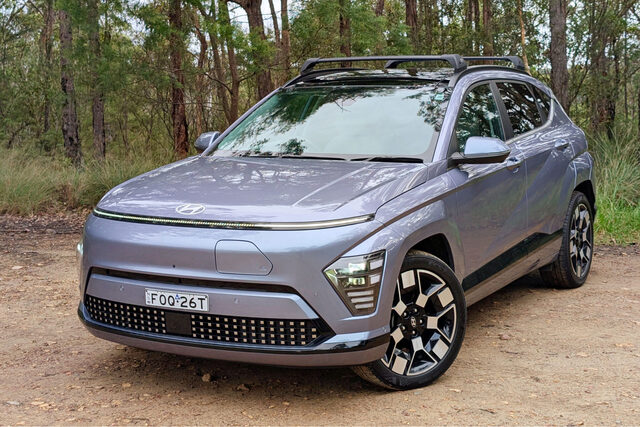
The sporty N Line option pack brings the price of the basic version to $62,000 and the Premium to $71,000. Any colour other than white or green adds $595. The optional Meta blue of our car appears mauve in some light. N Line includes body-coloured cladding, exclusive bumpers, skid plates and side effects, wing-type rear spoiler, 19-inch alloy wheels and N Line badges/wheel centres
Our test vehicle was the top of the line Kona Electric premium with 19-inch wheels, premium paint and optional interior trim, priced at $68,890 plus on-road costs. Standard features include 17-inch alloy wheels, LED headlights, DRLs and tail lights, dual-zone climate control, interior Vehicle To Load (V2L) power outlet, heat pump cabin heating, battery conditioning and a wireless smartphone charger.
Premium adds 19-inch alloys, leather upholstery, powered, heated and ventilated seating, a heated steering wheel, head up display (HUD), Bose eight-speaker premium audio, remote smart parking, wide glass sunroof and a power operated tailgate.
On another note, Kona Electric is the first EV in its segment to come standard with a spare tyre, which is comforting when it comes to longer journeys.
Kona Electric is covered by a five-year/unlimited-kilometre warranty, with a separate eight-year/160,000km warranty on the battery. Service is due every 24 months or 30,000km.
INFOTAINMENT
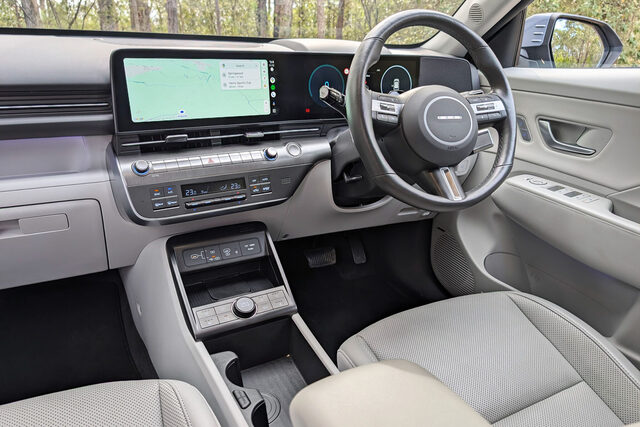
Infotainment consists of 12.3-inch touchscreen together with a 12.3-inch instrument cluster that sit behind a single seamless glass panel.
It has a long list of features including Hyundai Bluelink and Over-the-Air update capability, improved natural language-based voice recognition, and a dedicated EV user interface.
Other features include Bluetooth with multi-connect, AM/FM and DAB+ digital radio, satellite navigation, along with wireless Apple CarPlay and Android Auto.
A 240-volt three-pin socket can be found at the rear of the centre console, which we used to power a car fridge.
There are two USB-C ports in the front and another two in the back, but there’s no power outlet in the actual luggage area.
SAFETY
Despite an extensive list of active safety and driver assistance features Kona scores only four stars for safety.
It falls short in two key areas: safety assist and vulnerable road user protection, achieving only an adequate result in the performance of its autonomous emergency braking system in tests with pedestrians and cyclists.
POWERTRAIN
The electric powertrain in the extended version produces 150kW of power and 255Nm of torque, with drive to the front wheels through a single-speed reduction gear.
DRIVING
Second generation Kona Electric is bigger and roomier, 18cm longer with a 6cm longer wheelbase than its predecessor. This means a bigger boot and more legroom, with 7.7cm more legroom and 1.5cm more headroom in the back. Seating is comfortable without being inviting and perhaps a bit narrower than before.
Heating comes from an energy-saving heat pump, with physical temperature controls below the touchscreen.
Up front you get two retractable cupholders, a 1.5-litre drink bottle holder in each door and generous centre console storage. In back there’s 700ml bottle holders in each door and a fold-down centre armrest with two cupholders.
The luggage area has grown by 33 litres to 407 litres, with a 27-litre plastic frunk up front which is handy for stashing charge cables.
Never quite rising above its humble origins, hard plastic abounds in the cabin, disguised by soft touch material in such places as the armrests. Lifting the tailgate exposes a luggage area that looks oh-so-average in generic grey felt.
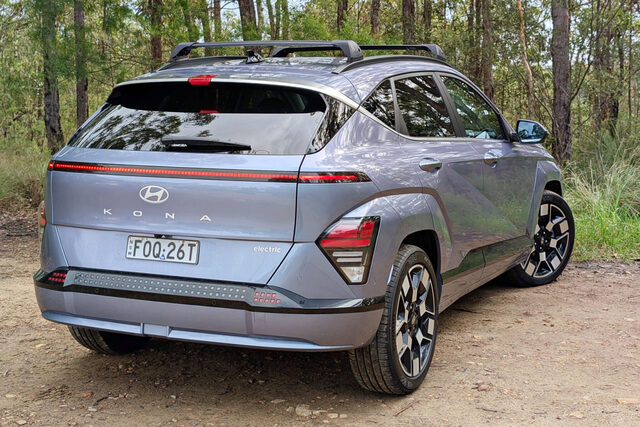
The look is distinctive with a long thin light bar that spans the breadth of the bonnet, matched by a tail light strip at the rear, which together give the car a space-aged appearance.
Both strips of lights are underpinned by large separate head and brake light assemblies. Studded, pixel-like inserts at the front and bottom of the rear bumper underline the futuristic look.
But to get the cooler, high-flying rear spoiler you need to shell out for the N Line kit.
Some iterations of the car look a bit goofy, but from Hyundai’s point of view there’s no mistaking the Kona for anything else on the road.
An ‘active’ air flap opens and closes to reduce wind drag at the front and, believe it or not, extended range versions are pre-wired for towing and can pull a 750kg braked trailer. Even more incredible is that this EV actually comes with a spare wheel, albeit a space saver – unlike the rest of its kind.
On a lesser note, Kona Electric is built on 400-volt architecture, so it does not offer the faster charging speeds of other Hyundai EVs.
There are four drive modes – Eco, Normal, Sport, Snow – plus iPedal one-pedal driving (no need to brake separately).
With 395Nm of torque the first generation could accelerate from 0-100km/h in 7.6 seconds. Heavier and with less torque, this one does it in a slower 7.9 seconds.
Steering wheel mounted paddles can be used to control the level of regenerative braking (lesser or greater brake drag). There’s also a smart mode.
With a DC fast charger, Hyundai claims 10-80 per cent charging can be achieved in 41 minutes, compared to 18 minutes for some of its 800-volt models.
The liquid cooled, high-performance lithium-ion battery is incorporated in the floor plan, maximising interior space and providing a flat floor.
Putting the battery down low gives the car a lower centre of gravity which enhances ride and handling, and sees it sit flatter through corners.
The charge port is located at the front of the car where it is arguably more convenient to use. The capacity of the onboard AC charger has been boosted to 10.4kW, compared with 7.2kW in the previous generation. But that requires a home with three-phase power and higher charging rates are really not required for overnight charging.
With single phase power and a 7.2kW EVSE, the 48W standard range version can be fully charged in 6.75 hours, while the 64kW extended range will take up to 9.0 hours.
Plug it in when you get home and it will be ready to go again in the morning.
Topping up the car from a 300W Tesla Supercharger took much longer than expected and never even came close to the promised 100kW level.
Kona also provides vehicle-to-load (V2L) support, but leveraging the full capability means buying a $600 V2L connector.
Energy consumption for this spec version of the car is a claimed 16.7 kWh/100km.
Our test vehicle was showing the long-term equivalent of 16.1 kWh after 2480km. We say equivalent because the trip meter was set to km/kWh not the usual kWh/100km, and we could not find how to change it – not for lack of trying.
Moving from the Ioniq 5 straight into the Kona Electric was enlightening. They share the same twist-style transmission lever which is located on the right of the steering column and same basic layout.
The big difference is in the way Kona rides and handles. Although tuned for Australian roads, the ride is noticeably harsher and it is less able to absorb road shock, due mostly to its smaller size.
The bounce that characterises EVs is also present and sees the car bob up and down when it encounters a large bump such as a speed hump.
Rather than sporty the Kona Electric is easy and relatively comfortable to drive around town, but we suggest it is better suited to shorter trips. Its size will make it tiring to drive over longer distances and country roads are likely to produce a choppy ride. It’s quiet inside, but there’s some wind noise, even at lower speeds. Head-up display is almost invisible to those who wear polarised sunglasses.
Like the Ioniq 5, the over-speed warnings are often wrong and can be annoying, but are reportedly quieter and can be switched off – though they must be disabled each time.
A ‘Virtual Engine Sound’ (like a Tesla) is emitted from a front-mounted speaker to warn pedestrians of the car’s approach, and adds to the spacey persona. It was loud enough to draw an audience while we were doubled-parked, and trying to load some gear into the back.
Android Auto threw us a curve ball when we were unable to navigate back to the car radio screen and select a band and station to listen to.
SUMMING UP
Kona Electric is a well-engineered, well equipped small crossover style wagon that doesn’t cut many corners. But the result of this strategy is an unexpectedly high price tag, perhaps too high.
Tick all the boxes and the Kona is just over $77,000 by the time you put it on the road. And that’s before you start thinking about installing a Wallbox at home which is really the only practical solution to charging. It means you won’t be constantly worrying about when and where you can charge your shiny new toy.
At this point thoughts will probably turn to cheaper Chinese alternatives. Kona’s Main rival is the BYD Atto 3 which tops out at $47,499 plus on-roads.
Over to you.