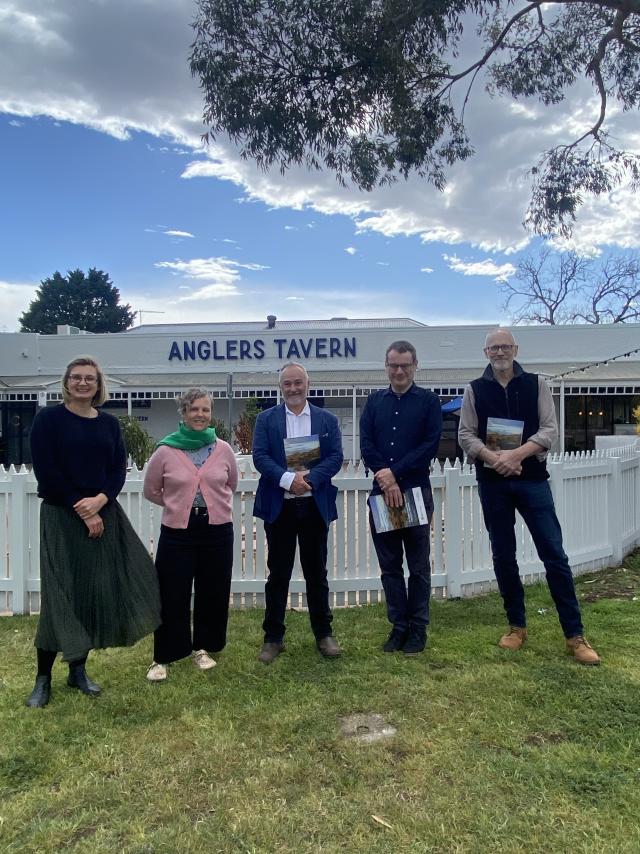
Community leaders, Traditional Owners, planners, and environmental advocates gathered at the Anglers Tavern on the banks of the Maribyrnong River on Friday September 19 for the launch of the Single Living Entity Concept in Planning for Waterways report.
The report, commissioned by the Concerned Waterways Alliance and authored by planning expert Stephen Rowley of RCI Planning, argues that Victoria’s waterways must be treated as “living, integrated natural entities” in planning law and policy, a principle already enshrined in the Yarra River Protection Act and now extending to the Maribyrnong and other western waterways.
Derived from the thinking of Indigenous peoples in Australia and overseas, as well western cultural approaches to the natural world, the single living entity concept views a natural ecosystem as a unified whole with the right to exist, thrive, and evolve as an integrated living system.
The event hosted by the Maribyrnong River and Waterways Association (MRWA) featured a panel discussion with thought leaders in planning and water policy, including Uncle Tony Garvey (Wurundjeri Elder), Stephen Rowley himself, Claire Romaskzko from the Department of Transport and Planning, and Alex English, senior planner at Merri-bek Council.
How to overcome a fragmented decision-making process across councils, and how to better embed Indigenous-informed perspectives into planning schemes were among the topics discussed.
“Rivers are more than just channels of water, they’re living systems that connect landscapes, cultures, and communities,” said MRWA operations and advocacy lead Nicole Kowalczyk.
“The living entity approach is about giving waterways and their surrounding parklands the respect they deserve and not encroaching on their space.
“It’s about giving rivers the space to move so they can provide the many ecological services they offer from flood mitigation to building climate resilience. ”
Attendees also discussed the next steps for policy reform, including stronger planning overlays, better resourcing for catchment authorities, and genuine empowerment of Traditional Owners in decision-making.
The message from the report and the panel discussion was clear: protecting the Maribyrnong and its tributaries means thinking bigger than individual planning permits. It means treating the river as a living neighbour, not just as a backdrop.
For a copy of the report visit: https://concernedwaterwaysalliance.org/