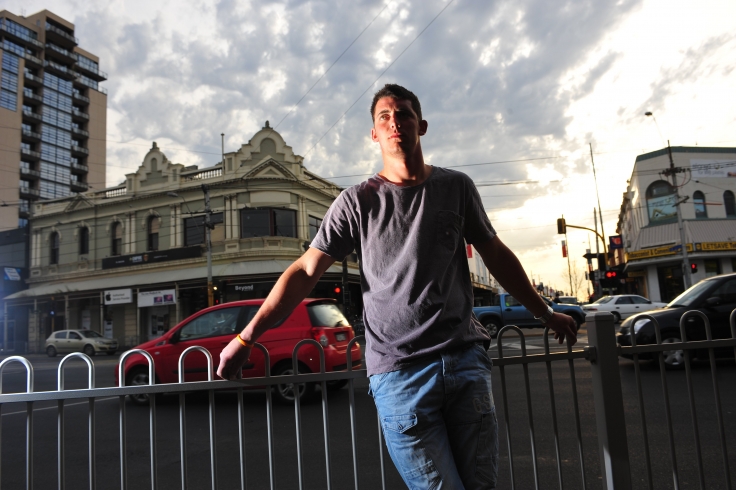
IT was a mild summer night in 2008 when Gavin and Denise Mitchell were told their son wouldn’t make it through the night.
The piercing sound of the phone ringing roused them from their sleep. Each ring, more urgent, more panicked.
David Mitchell, then 19, was in an ambulance being rushed to the Royal Melbourne Hospital.
What had begun as a night out with friends, would spiral into a year-long nightmare for the promising footballer and his family.
Less than a kilometre from their Moonee Ponds home, at a nightclub then known as One Bar, David was king hit from behind after he had attempted to break up a fight between his friends and a group of strangers.
As he lay lifeless on the ground, his attacker kicked him in the faceand stomped on his head another three times.
His friends dragged his body from the middle of the road the attacker fled down Puckle Street.
Doctors would later tell his family his head injuries were consistent with those of a high-speed car accident victim.
“When we arrived at the hospital we were told Dave wasn’t going to make it,” Gavin Mitchell says. “We were told to gather the family. Then there were two or three days where Dave was in a life-and-death situation. After we knew he wasn’t going to die it became, well, what were we going to get back?”
According to Australian Institute of Health and Welfare research published in 2008, more than 3450 people are brain-damaged as a result of assaults every year.
Researchers estimate that 47 per cent of all those who commit violent crimes and 43 per cent of victims of these crimes are under the influence of drugs or alcohol prior to the event. Men under the age of 34 make up the majority of hospital admissions for alcohol-caused assaults.
The Mitchell family refused to give up hope.
David’s parents and four brothers spent endless days and nights in a vigil beside his bed.
When he finally did wake, he didn’t recognise them. He didn’t even know his own name.
“Gradually, day by day, he improved ever so slightly and we just never gave up hope,” says Gavin. “We couldn’t.”
David spent 12 days in a coma in intensive care, 39 days in post traumatic amnesia and the next nine months of his life in rehabilitation, learning to walk and speak again.
He couldn’t walk unaided for months.
Now 24, he only got to see what happened in those fateful moments of being attacked during a County Court case in 2009.
“I only know how many strikes, how many stomps it was because I had to sit through the court proceedings watching the CCTV footage,” he says. “All I kept thinking was how can someone have that going through their head. To stand on a lifeless body, to stomp on it, continue to flatten, to destroy, to kill . . . I don’t see how it is human to do that.”
David’s attacker, then 23, had been thrown out of the nightclub earlier.
Prior to the attack, he had been involved in a drinking competition with a friend and consumed a bottle of Southern Comfort whiskey and then vodkas at a St Kilda bar.
He had walked up to David’s group of friends, claiming he’d been hit with a bottle.
David, acting as a peacemaker, intervened.
“I said, ‘Mate it wasn’t any of us. Let’s go upstairs, have a drink and forget it. We shook hands. I don’t remember what happened next.”
In August 2009, the attacker was sentenced to six years in jail.
Denise Mitchell says there were no winners in the ordeal and watching the footage of her son being senselessly beaten was gut-wrenching.
“For me, it shows how quickly a situation can change,” she says.
“That Dave was shaking this fellow’s hand and then when he turned he hit him to the ground. It was just horrific. In those minutes that followed this young boy has ruined his own life, his parents’ lives and his grandparents’ lives.
“Your life can change in that moment and there are no winners.”
After the court case ended, it remained a long, emotional and painful road to recovery for David.
His love of playing football was shattered after doctors told him he would never play contact sport again. Then he was forced revise much of what he learned during his carpentry apprenticeship.
“It was demoralising,” he says. “I was six months into my apprenticeship, but when I returned to work a year after the assault I couldn’t remember anything. I had to start again and re-learn everything.”
David says it wasn’t until this year that his anxiety and trauma began to fade.
“I’m only just feeling like me again,” he says. “People thought I was back to my old self, but I wasn’t. For a long time my trust levels with people would go up and down. I didn’t feel as comfortable going out with mates. I didn’t trust strangers straight away. I would spend nights out looking around, trying to read conversations between people and becoming anxious, thinking something was going to happen.”
Eighteen months ago David was ready to take a stand for the silent victims. He decided to be a voice for the victims whose lives had been stolen or destroyed by the street violence that has ravaged Australia in recent years.
A poignant visit to James Macready-Bryan, the victim of an alcohol-fuelled assault in Melbourne in 2006, led him to become an ambassador for Step Back Think.
Mr Macready-Bryan was cornered in a dead-end alley before being punched in the face and hitting the ground on his 20th birthday.
He suffered brain damage and is now unable to move, talk or feed himself, and lives in a high-care residential centre.
To raise awareness of the devastating impact a single punch can have, his father Andrew Macready-Bryan, family and friends formed Step Back Think in 2008.
The campaign, funded by the state government, educates young people to step back and think of the consequences of throwing a single punch. It aims to change attitudes towards street violence.
“When I met James I thought that could have been me. I could have been just a heartbeat. I’ve got to do something about this,” he says.
“Its not just a CBD issue; it’s everywhere, it’s wherever there is alcohol or wherever there are two opinions in the one place. It could be at your local suburban football club or the nightclub in the city.”
Every year for the rest of his life, David will visit a specialist who examines his brain and performs a series of tests to examine how his brain is functioning.
Earlier this year, after hearing about a recent fight involving people he knew, David posted on Facebook about the dangers of alcohol-fuelled violence.
His status update received more than 150 “likes” in 48 hours.
“I don’t see myself as inspirational or anything like that. I just want to stop this from happening to somebody else,” he says. “If I can reach just a couple of people through the campaign, force them to think before they act, then I’m happy.”
David says he plans on raising the profile of Step Back Think among football clubs in the west. During the footy season this year, he spent every Sunday mentoring the St Bernards Football Club under-14 players.
His message is simple.
“Always look out for your mates,” he says. “Just walk away and be the bigger person.”
Tough love for boozy youths
Keilor Downs Leading Senior Constable Gerard Dickinson worries about “an unprecedented increase in street violence in the past five years”.
As a youth resource officer in the west, he mentors more than 400 young offenders and victims of assault or road trauma.
It prompts him to observe: “There’s growing acceptance among young people about the use of recreational drugs.”
“Youth are also drinking a lot younger. If you have drugs and alcohol in the mix, violence is just a given.
“Its these attitudes of young people who aren’t prepared to think about the consequences of their actions that need to change.”
To curb this type of behaviour, police officers in the west have created a series of diversion programs for youth.
They are:
■ Preventing Alcohol and Risk Related Trauma in Youth (PARTY) — run in conjunction with The Alfred hospital — is a pre-sentencing condition where offenders aged 18 to 25 visit victims of assault and road trauma in the intensive care unit.
■ Ropes, a crime diversion program for youth under 16, teaches those who have been in trouble with the law about the consequences of their actions. It uses heights and rope-scaling to challenge young offenders and instil a sense of discipline and self-worth.
■ Fit2Drive has schools across the west taking part in a safety initiative that aims to raise awareness of the consequences of drink-driving and risk-taking on the roads. Presentations are given by road trauma victims, firefighters and police officers.
For more details on these programs, call 9365 3333. Learn more about Step Back and Think or donate to the campaign at stepbackthink.org